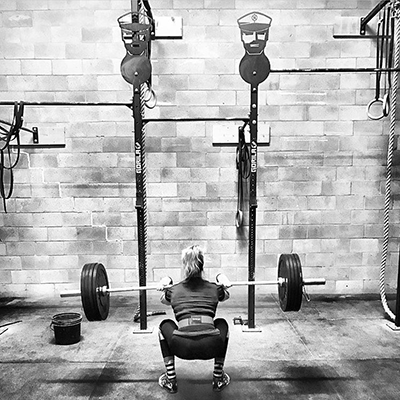
 The craze for CrossFit has been growing for several years now. Developed in California, this method was designed to prepare athletes for unpredictable training with exercises involving functional movements, varied exercises, and transitional intensities.
CrossFit is a workout that echoes your routine, the activities you must perform in daily life. A simple example: lifting a load. Whether moving furniture or storing boxes, the squats you do or bending at the waist are functional movements. So, instead of isolating specific muscles like gym machines do, CrossFit targets the whole body.
Varied training encourages physical effort stimulation and drives away boredom!
CrossFit draws inspiration from weightlifting, athletics, and gymnastics, making it a complete sport.
Ten fundamental athletic qualities are developed during the practice of this sport:
- Muscular and cardiovascular endurance
- Strength
- Flexibility
- Power
- Speed
- Coordination
- Agility
- Balance
- Precision
The whole body at work!
 We can therefore confirm that CrossFit develops the body as a whole, since all joints and muscle groups are engaged. If the athlete already suffers from an injury or faulty motor pattern, chances are this dysfunction will surface or worsen during their “WODs” (Work Out of the Day). This dysfunction can certainly be corrected through gradual progression and integration of complex movements.
You must know how to “scale” your training!
A warm-up that prepares you!
As with any sport or physical activity, the session must begin with a warm-up to properly prepare the body for the movements and the intensity it will have to deliver. The warm-up allows better cardiovascular adaptation and improved muscular, joint, nervous, and tendon preparation.
CrossFit requires learning very complex movements such as “muscle-ups” and “power snatches.” It is crucial that the athlete respects their progression and fully masters the technique before increasing load, volume, and intensity. Skipping steps is a golden rule to prevent injuries. Slow progression that respects your injury history will pay off in the long term. Second golden rule: always prioritize technique over repetitions.
Chiropractic and CrossFit
As a chiropractor, unfortunately, we often see athletes of this sport in our offices. Very often, people want to go too fast and lift too heavy, too quickly. Chiropractic, like CrossFit, works globally. The chiropractor evaluates the athlete as a whole and makes a neuro-musculoskeletal chiropractic diagnosis. Qualified trainers in gyms where this sport is taught will require you to start with the basics — please, listen to them!
It is true to say that CrossFit will help the patient daily, whether in moving loads or simple neuromuscular control, such as contracting the right muscle with the right force at the right time.
Chiropractic adjustments also support this. By correcting spinal dysfunctions as well as muscular tension, adhesions, and nerve compressions, the chiropractor ensures proper joint function for effective training and optimal performance.
Too many injured athletes continue training despite pain. Not only can the condition worsen, but technique may also be incorrectly altered. Injuries usually occur when there is muscle fatigue and movement is no longer controlled. The nervous system will try to find an alternative painless route, in other words, a compensation that protects the injured area.
Collaboration between the trainer and chiropractor is encouraged for the athlete’s greatest benefit. The chiropractor can guide them through recovery and return to sport.
Need an evaluation?
If an injury worries you or prevents you from doing certain exercises, don’t hesitate to contact us for a better assessment of your health condition.
Dr. Sophie Pesant, Chiropractor
PRAXIS Family Health Clinic
References:
- Are Injuries More Common with Crossfit Training than other Forms of Exercise? Chelsey Klimek1, Christopher Ashbeck1, Therapy Program Student, University of Wisconsin—La Crosse, La Crosse, Wisconsin, United States.2Student Health Center, Physical Therapy
- Injuries in strength training: review and practical application, vol. 32, 2014, Butragueno, J. Benito, P.J., Maffuli, N., European Journal of Human Movement
- Shoulder Injuries in Individuals Who Participate in CrossFit Training, Ryan J. Summitt, Ryan A. Cotton, Adam C. Kays, vol 8, #6, 2016, Sport Health: A multidisciplinary approach
- CrossFit enthusiast, ACQ, 2017